Blog

English: Stockholm

Stockholm Fossil free 2040

Introduction:

As an exchange program we, second & third year bachelors, went a week to Sweden. We visited a lot of start-ups, district heating facility’s, energy plants, but also big companies like ABB & Atlas Copco. The one I found the most fascinating was the presentation given in the Stockholm city hall. Where they explained how they want to be fossil free in 2040. To achieve this goal they made three big category’s: Sustainable energy use, Transport & Recourse-efficient natural cycles.

Sustainable energy use

This part deals with the energy use of houses, industrial buildings, trade. This is divided in two parts, heating & cooling,  electricity & gas. This sector takes more than half of the energy consumption. Since 1990 the energy consumption of Stockholm is more or less the same. However the amount of buildings that need to be heated & cooled are almost doubled. They are building off the use of fossil fuels to almost zero because they are closing the old powerplants and are building new ones that use bio-fuels. Now there are also state of the art new energy & heat plants that run on waste but they don’t plan on burning to much waste because it is 30% plastics & those are also derivates of crude oil. Also buildings like hospitals have back up generators running on oil. They can’t be replaced easily because of Swedish law. The electricity in Sweden is so cheap that nuclear plants aren’t profitable. They are exchanged for windfarms. Also the swedes themselves are placing solar panels. As they state that the more expensive energy becomes, the cheaper the renewables. As in the future more demand is needed, prices go up. By 2040 they hope to need only 1-2% fossil fuels across all Nordic countries. Instead of eliminating gas uses they just replace the fossil gasses for biogases. They aim to meet demands by collecting 70% of the food waste. The planned factory should be up and running in 2020 and will reduce the C02 by around 20.000 tons each year.

Transport

As the live expectancy of a car is about 20 years they want every car sold form 2020 to be adaptable to green transport, this may include electric, hydrogen, hybrid powered vehicles. This also means that the city must improve their charging & docking stations to recharge the cars. Furthermore the city asks the state to write laws that reduce taxes on green cars for example.
They also want to reduce private cars on the road and create a good and improved public transportation network. If the private car number in the city would go down, the public transportation & the delivering of goods will go more efficient and the air quality would be better.

Recourse-efficient natural cycles

The idea is to reduce fossil fuel but also the derivates, like plastic bags. As it is currently being burned as a fuel it is still a fossil one. Burning it for heat and electricity is better than putting it in a landfill.
This is but a small summary of what we heard. For more information you can use the link below. Everything I used for this paper can be found here : http://international.stockholm.se/globalassets/rapporter/strategy-for-a-fossil-fuel-free-stockholm-by-2040.pdf

English: Backpacking

Backpacking:

Travelling with a backpack

Intro;

Last year after the end terms I had a few days spare time between my last test and my first camp.
My function on that camp, I think they call it youth counselor, I’m kind of in charge of the adventurous side. We take the youth from our town and we go camping in the Ardennes (kind of mountains in the east-side of Belgium).
As we sleep in tents for at least 11 days and living without warm water, good nights sleep, or even worse no internet!
To get in the mood I wanted to go on a multiple day hike through the north of France.

Preparation

First and for all: a plan!
On a second though no plan just go! Take essentials and go!
These essentials include;
A hammock tent I just bought online; a pretty cool hammock with a cover and a mosquito net.
Clothing: Some T-shirts, slacks, socks, a hat,….
A “gamel”: it’s a square shaped aluminum kooking -pot/-pan/dish
A camping fire; ofcourse how would I be able to cook otherwise?
Food & drink; I prefer weight efficient food; rice & veggies, for drink I make sure to always have 5 L. I’m going hiking not surviving in the wilderness.
Utilities: matches, rope, cutlery,…
Last but not least my dog. She doesn’t need much a leach and food

Destination

For a general direction I wanted to go abroad, this means, The Netherlands, Luxemburg, Germany & France.
Next criterium is: is it legal to camp in the wild?  For the Netherlands & Luxemburg it isn’t. This leaves only Germany and France. Where do I get the easiest? France is pretty accessible by train, crossing the border by train costs a lot. So I start looking for train station close to the French border.
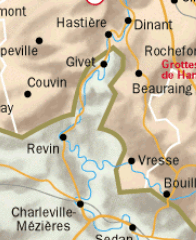
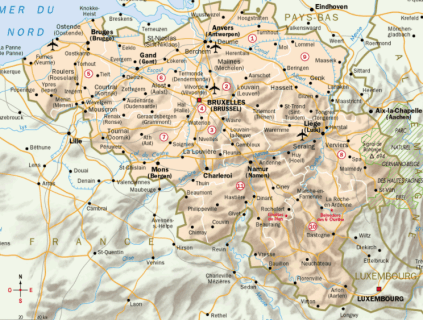
My eyes fell on this spot:
1

A closer look:

2

In Beauraing there is a train station!

Day 1, Wednesday 21th of June

I have my backpack, my dog, a direction.
I had my last good nights sleep I woke up around 10 am, ate breakfast & headed to the train station. I had to switch trains 3 times, first to Ottignies where I got on the train to Namur, Once I got there the all trains were delayed or canceled because somebody made a fake bomb report. Luckily my train to Bouillon was one of the few that still was driving. I Arrived in Beauraing at 3 pm France was still a 10 km ( 6 miles walk ). I walked for Fromelennes. A small village that lays in a valley surrounded by hills. I could’ve walked straight to Fromelennes but that would be hard less an adventure. So I went south, I walked over hills trough woods not knowing anything besides I was going south-west. As I arrived there was no place to hang my hammock so I continued for Charnois. A small farming village with no more than 100 inhabitants. I wasn’t able to get there before sun down so I found some trees, cooked dinner and went to bed, for this day I walked more than 20 km or 12 miles with a backpack of 20 kilograms or 44 pounds. The route I walked contained a lot of hills so I was pretty tired.

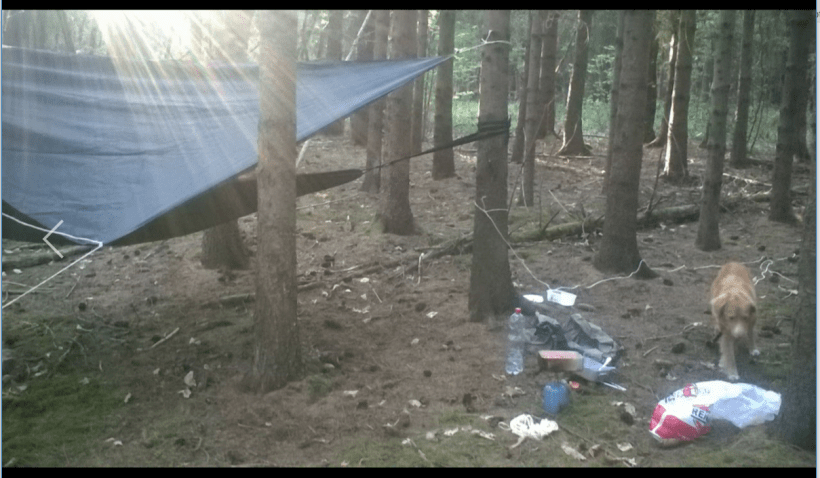
My sleeping spot looked like this
3
As You can see a beautiful scenery. With my hammock to the left & my dog with my cooking gear to the right.


Day 2 Thursday 22th of June.

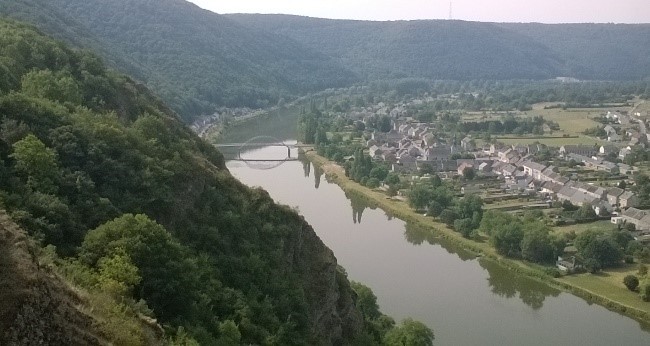
The first day you go for a nap in the nature, it is always a bad one. New day new challenges! Objective of the day getting to the river. What I forgot to mention is that there was a heatstroke at the moment, my 5 liters of water was already gone. So assertive as I am, I asked for some water at some residents. Whilst having a conversation with the residents, I also got directions to the river and they pointed me to a shortcut however you will have to hop over some fenced wired. With a freshly replenished drink and a new heading I hiked onwards towards the river. Yet I arrived at a cliff looking over the river, and I had to fight through some tough wilderness to get to the river bank.
4

After reaching the river bank I was not even 10:30 so I headed to Givet which is a small medieval city with a citadel. This is also the last town before the border with Belgium again. I reached there around midday however around this time it was the hottest part of the day and I already drank my 5 Liters of water. So I restocked with 3 more liters and I was just able to get to shade where I crashed down. Me & my dog we were overheated we stayed in the shade resting for an hour or two. Whilst resting I had time to think of my return home, so I had to find a train station. My eye fell on Anseremme a village I’ve being before around a 40 km walk, if I hike 15 more today, then the last day I would’ve just need to do 25 more! With the easiest route ever: Following the river.
After the hottest part of the day I started following the river which led into a small nature reserve where some rare and endangered birds could be found. Again my water supply is running low, but sufficient for today. At 5 pm I crashed due to exhaustion, my sleeping place a bridge I secured my hammock to rails attached to the bridge. After a quick meal I just rested until dusk to go to bed and sleep.

Day 3 Friday 24th of June.

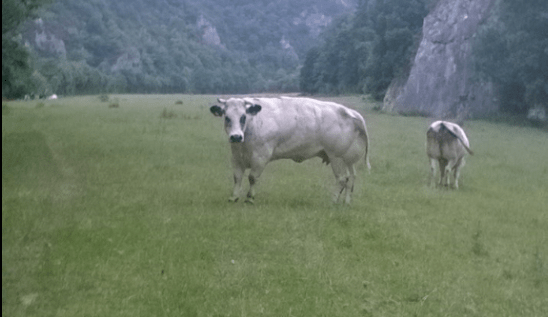
This was a bad night some animals were coming close to me in the middle of the night. So my dog was barking a lot. To add insult to injury there was a construction a bit down the road so heavy loaded trucks passed the bridge starting 5 am. At 6 I was awake and ready to go. First priority of the day: get water. Just across the water there was an elder couple also awake and they offered me water, I thanked them and went on my way. I made good progress as it was still cool and early at a certain point I had to enter a fenced area at the river. In this area cows roamed and could do as they bid. It was also the first time my dog saw cows from close and I had to walk close to them. Meanwhile praying that my dog won’t startle the herd of cows.
5

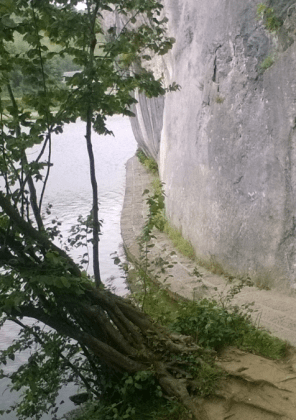
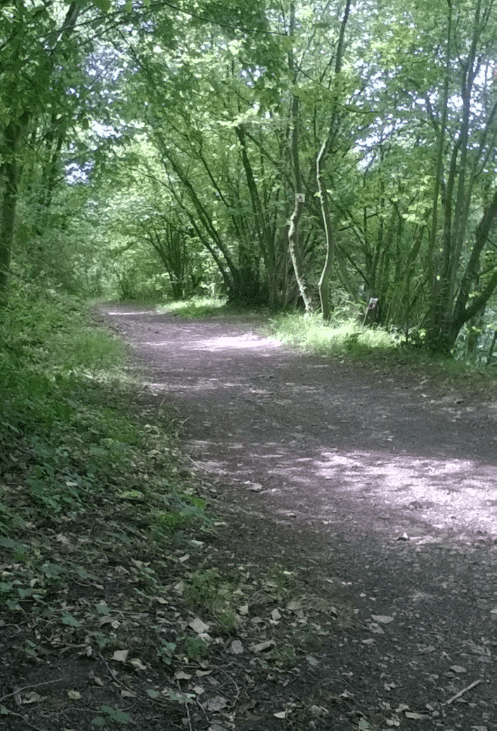
In the middle of that area was a family camping. I mean the whole family, from grandparents to children. They fenced in a little part of the meadow with sticks and branches. They had tents, hammocks, a few dogs, a boat,…! As you can see there is a train close to the cows who didn’t move a bit. In the distance you can see the tents of that family. This closed area led into the nature reserve “Freyr” this is a very common spot for mountain climbers. Through this nature reserve runs a “G.E.” route this routes are an abbreviation for Grands Routes. They can be found trough whole of Europe and take you to the most beautiful places in Europe.
They were not lying:
67

This breathtaking trail ended in Anseremme where I had a train and I got home in the evening where I had a really big meal.
It was a really short trip but do not underestimate it I walked 25 km each day with 20 ish kg in heat of 35 degrees.
It took me to places I never was before, I met some interesting people.
It took a lot of blood sweat and tears but it was worth it.
Time to start planning my next expedition.


Pieter-Jan Bogaerts,

Nona the dog,
English: Biofuels

Biofuels


In this paper I’m going to translate roughly the paper I had to do in my first year bachelors degree in Energy management.

Biofuels,

What are biofuels?
When energy is harvested from a living organism we consider (animal, plant,…) this a biofuel
However you can’t just use a ton of grass as fuel. First you have to modify it, this can be done using biologic, physics or chemic processes
If the organism is long dead before it is used as an energy source it is not biofuel (e.g.: coal)

History

A short summary of biofuels through the ages,
A long time ago they already knew fire, the ancient humans used wood which is a biofuel. Still I wont be talking about fire.

Between the 18th -19th century they hunted whales for its oil, but excessive fishing made the population of whales shrink and demand was too high. The whale oil was to expensive so it made way for the cheaper fossil fuels.
In the 20th century  the price of fossil fuels rose, because of this there were a lot of farmers who planted crops for fermentation to make bioethanol. However the prohibition in the USA reduced the technological advances on ethanol.
At last in the 20th scientist all around the globe agreed: fossil fuels are not infinite.

Processing

Physically

The easiest way to make biofuels is using physical ways, like: boiling, pressing,…
This is how they make wood chips.
This method has some boundaries, you can’t use to humid material and not everything is suitable for this processing.

Biologically

The best part about this way of processing is that everything can be used as fuel.
This is how it works;
They toss everything into a big tank
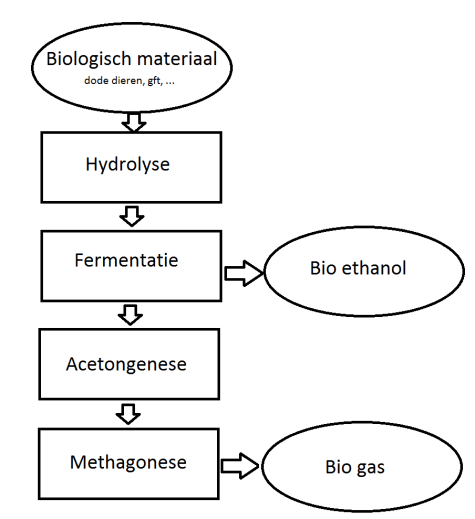
In this tank they will start a process called: Hydrolysis
Every large molecule is sliced into smaller ones by using a water molecule  – Hydro (=water) & lysis (slicing). This is necessary because in the next step, the microorganisms can only process relatively small molecules.
The second step: Fermentation
In this step the stuff we made prior comes into another tank. However this one is air sealed. No air can enter or leave. In this tank are microorganisms (the same ones used for making beer & wine). These make our bio-ethanol. This doesn’t have to be the end of the road. If we want to make biogas we can take the rest of the tank and go to another step called acetogenic.
In this step we take some molecules the are left by the microorganism and transform them into acetate, hydrogen, and carbon acid.
This 3 molecules can be combined into biogas.
This is the most common way to make biofuels.

Chemically

Just burning is the easiest way to gain energy from biofuels however you can’t just burn everything!
A second way gasification is used in the chemistry world to gain valuable gasses. In order to obtain these gasses you need to heat biofuel in a special tank to 1100-1500°C (2010-2730°F). You can already see that this one is very expensive.
Biodiesel is also made chemically; you need a carbonic acid and ethanol mix them on a high temperature with some sulfuric acid and POEF biodiesel is made. No, actually it is very though to make this, because you need very pure components.

Future?

In the world there is yearly enough biomass made (growing new trees,…) so we can feed to current consumption worldwide 4 times. Needless to say is that we can harvest it but we need to improve a lot.


Ethics!

To me ethics is as important as technology, because of that vision this question rose:
How much fertile farming ground can we sacrifice to heat our houses and use as fuel in our cars as there is hunger in the world?

Bio-energie

In dit blog bericht ga ik m’n paper over bio energie kort toelichten, wil je het volledige verslag lezen, klik op de link onderaan de pagina.

Wanneer is een vorm van energie bio energie?

Wanneer de energie gewonnen wordt uit een levend organisme (plant, dier, …) dit wordt dan omgezet via chemie of biologie naar een energie vorm.

Energie uit “levenloze” objecten is dus geen bio-energie (nucleair, zee/wind,…), als je beroep doet op een dier voor energie te leveren bv; een paard die iets voorttrekt, wordt ook niet gerekend tot bio energie.

Geschiedenis

Er bestaat al heel lang een vorm van bio energie: vuur!
Toch gaan we dit niet bespreken we beginnen dus in

-18e- 19e eeuw:
knipsel
Er werd verwarmt op walvissenolie, na een tijd daalde de walvissen populatie en verwarmen met die walvissenolie werd duur; een stap naar de petroleum werd gezet door kerosine te winnen uit ruwe aardolie; Toch werd er een verbrandingsmotor uitgevonden die werkte op ethanol & terpentine (gewonnen uit dennebomen). Deze uitvinding werd niet echt gebruikt omdat de fossiele brandstoffen goedkoper waren.

-2oe eeuw:
de prijs van fossiele branstoffen steeg, er werden massaal gewassen geteeld om deze te laten fermenteren voor (bio-) ethanol. Toch kent ethanol een terugslag toen in de USA de prohibition een feit werd. Ook werden motoren en auto’s uitgevonden die werkten op fossiele brandstoffen en ethanol (fort model T). Er waren veel fluctuaties op de prijs van fossiele brandstoffen door oorlogen, crisissen, revoluties,… dit kwam de productie van bio-energie te goede.

-21e eeuw:
Globaal wordt het duidelijk; er is geen oneindige de hoeveelheid fossiele brandstoffen.
Er wordt over de hele wereld overgeschakeld op gewassen om bio-energie te produceren. Hierbij wordt deze vraag gesteld: Hoeveel vruchtbare landbouwgrond kunnen we spenderen voor de productie van energie t.o.v. productie van voedsel?

Werking

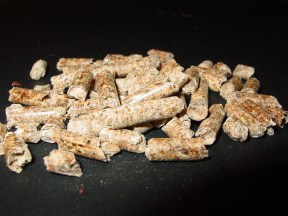
-Fysisch: er wordt een vorm van bio-energie gemaakt door fysische processen, koken, persen,… een goed voorbeeld is hout-pellets.5641435582_6642889d60_b

-Biologisch; Hier worden micro-organismen zoals bacteriën gebruikt, en ziet er altijd zo uit; deze methode is ook de meest gebruikte

flowchartbio

-Chemisch; hierbij gaan we vooral werken met hitte,
voor chemische verwerkingen zijn bv, pyrolyse, gasificatie (stadsgas), en verbranden (vuur).


Toekomst;r

Voor steenkool is de grootste bron van energie en jammer genoeg een van de meest vervuilende, gelukkige is er een opkomend alternatief; houtpellets;

Het gebruik van bio brandstoffen zoals bio diesel staat in z’n kinderschoenen, aangezien er regels zijn zoals; tegen 2050 moet 30% van de energie op basis zijn van bio-energie.
Wordt hier gerekend op een gigantische groei!

Problemen;

De ethische discussie:
Er komen als maar meer mensen op de wereld en de landbouwgrond is niet oneindig. Waar ligt de grens tussen landbouw grond voor eten of energie?

Cellulose;
Dit is een onverteerbaar suiker (“vezel”) als je dit niet kan afbreken kan je er ook niets mee doen. Micro-organismen hebben hier ook moeite mee.  Hierdoor zijn een groot deel van de planten niet bruikbaar voor de biologische productie.

CO2;
Jammer genoeg zijn al deze processen niet vrij van deze molecule.
Wat wel positief is, er wordt geen extra COin de atmosfeer gebracht.

voor het volledig verslag: klik “hier


Wordt 2017 het jaar waarin de ondernemer massaal kiest voor hernieuwbare energie?

Op 2 januari las ik bovenstaande subtitel in De Standaard.

Hier lees ik graag dat al 20% van de ondernemingen produceert al groene energie in een of andere vorm.

Hier beweren ze ook dat de zonnepanelen 20 jaar werken en je ze na 7 a 8 jaar hebt terug verdient.  Er willen ondernemingen nu investeren in zonnepanelen op daken of plaatsen die niet eens hun eigen zijn. Dit zouden ze doen in regeling dat ze dan zelf minder zouden betalen op hun energie factuur.

Dit is zeker goed nieuws voor de zonnepanelen die na de groene stroom certificaten en de Turteltaks een slag in het gezicht hebben gekregen, op gebied van populariteit ten minste.

klik (hier) voor het een link naar de site!

Het nieuwe jaar gaat alvast in de groene richting! zo lezen we het graag!